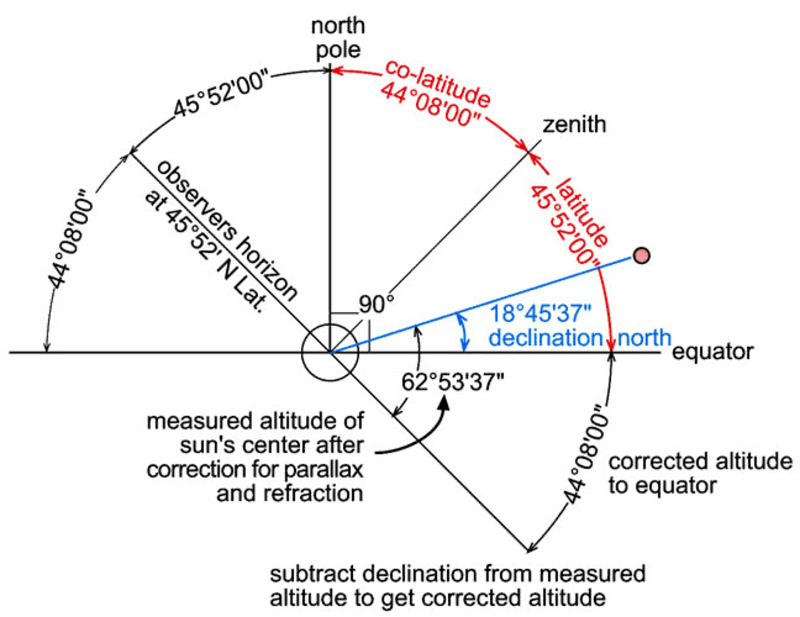
Now Lewis has the true altitude of the sun's center above the horizon but that altitude includes the sun's north declination. A celestial body's declination is the number of degrees that body is north or south of the celestial equator at a given moment as 'viewed' from the center of the earth. The declination of stars and distant planets changes slowly but the sun's declination changes by more than 23° between the equinoxes stopping only for a brief interval at the solstices. From the spring equinox until the autumnal equinox the sun's declination is North (+); the remainder of the year its declination is South (-). The angle that Lewis has just measured includes the sun's North declination. Therefore he must subtract the sun's declination from the result of Step F. If the declination had been south he would add it. The Nautical Almanac for 1805 that Lewis carried; however gave the sun's declination only for noon of each day at Greenwich England. Lewis thus has to determine what the sun's changing declination would have been at the time of his observation. To do this he has to make a separate set of calculations. How did Lewis determine the sun's declination at the time of his observation? a) Lewis looks in his Nautical Almanac for July. On page 74 in the column with the heading 'Day of the Month' he finds 29 and following across to the right to the column with the heading 'Declin. North' he finds 18°50'01" (July 29) and for the 30th he finds -18°35'44" (July 30) b) He subtracts the declination for July 30 from that for July 29 c) Then he divides that result by 24 to find the change in sun's declination per hour d) Now Lewis needs to know how many hours had elapsed between noon at Greenwich and noon at the Three Forks. The number of hours elapsed multiplied with the hourly rate gives the total change in declination since Greenwich noon. Lewis finds the number of hours elapsed by dividing his longitude by 15. He doesn't know his exact longitude, but he can estimate it or derive it by dead-reckoning. Lewis didn't save his calculations, so let's assume he used 111° West as his longitude: Therefore since Greenwich noon July 29 the sun's '04'24". e) Lewis subtracts this amount from the sun's noon declination. Finally, he subtracts the sun's declination from the result of Step F.