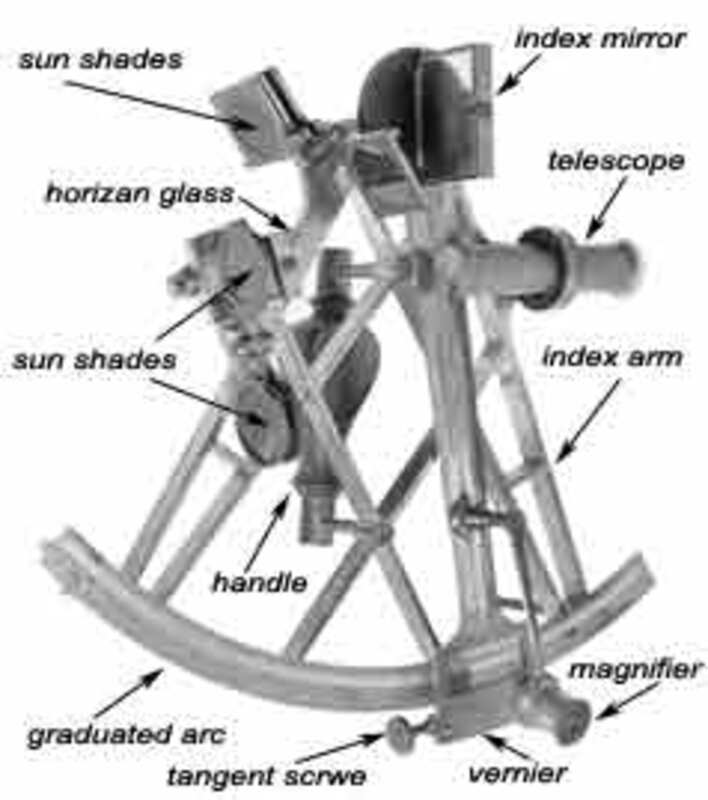
The sextant, invented about 1757, had the same 'A-frame' configuration as the octant, but its circular arc spanned an angle of 60°, that is, a sixth (Latin sextant) of a circle, and its index arm usually was 9-10 inches long. With its two-mirror system the sextant could measure the angular distance between objects that were as much as about 120° apart. The sextant was made of brass and had a telescope for sighting. Lewis and Clark used the sextant to measure the angular distance between the moon and sun or a star for longitude. They also used it for latitude when the sun's noon altitude was less than 60°. Although the sextant could measure an angle of up to 120°, the captains could not use the sextant to find the altitude of the sun when it was greater than 60° above the horizon because they needed to use an artificial horizon, which doubled the angle to be measured.