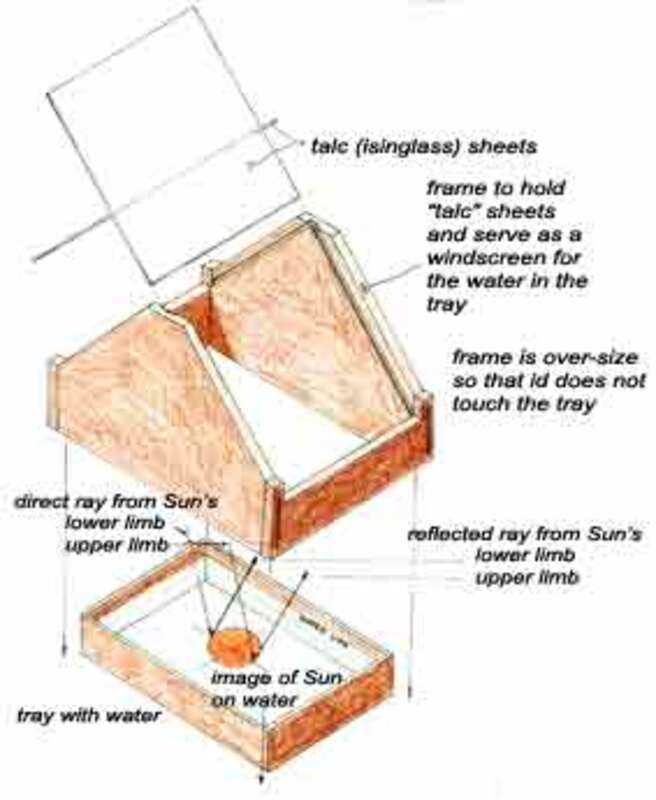
Artificial Horizons Navigators at sea could determine the altitude of a celestial body by measuring the angle between it and the true horizon. Inland away from the sea or a large body of water, however, one rarely has a true horizon. Therefore, on land, it generally is necessary to use an artificial horizon. Lewis and Clark carried three different types of them. Each design had its own advantages depending upon observing conditions. On bright days when the temperature was above freezing and the sun was being observed, Lewis and Clark commonly used a tray filled with water as an artificial horizon; the water made a level reflecting surface. The captains, however, used artificial horizons made from leveled mirrors when the temperature was below freezing. They also used them when observing stars because the image reflected from the mirrors was more distinct than from water. Robert Patterson, a Philadelphia mathematician and astronomer, had devised several types of artificial horizons using either a regular (single-coated) mirror or the double-coated index mirror from a sextant. The mirror was cemented onto a wooden ball and the ball was set in a wooden frame and adjusted by three screws used as legs. It was leveled with the aid of a spirit level.