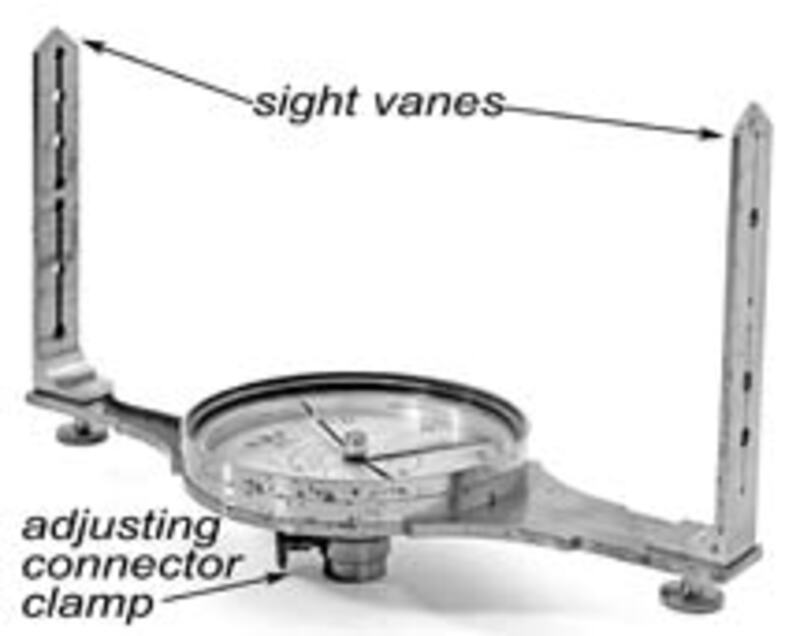
Lewis and Clark used the surveyor's compass to record their direction of travel and determine the bearing of celestial objects such as the sun and stars. Because the bearings they observed were based on magnetic north, they often took observations of Polaris or the sun at the junction of major streams or other important points to determine the difference between magnetic north and true north. Most maps are based on true north, which does not change through time or with location. The circumferentor was simply a six-inch-diameter magnetic compass, but was much more precise than the usual pocket or hiking compass and could be read to one-half of a degree. The circumferentor was equipped with front and rear sight vanes to help improve the observer's ability to sight precisely on an object. On the underside of the compass housing was a receptacle to allow it to be fastened on a tripod or to a shaped pole that was placed firmly into the ground. Attached to that receptacle was a ball-and-socket joint that allowed the user to level the circumferentor with great accuracy. A spirit level would have been used in conjunction with the surveyor's compass to establish a level plane from which to work. The circumferentor Lewis and Clark used was six inches in diameter and was divided into degree and half-degree increments.