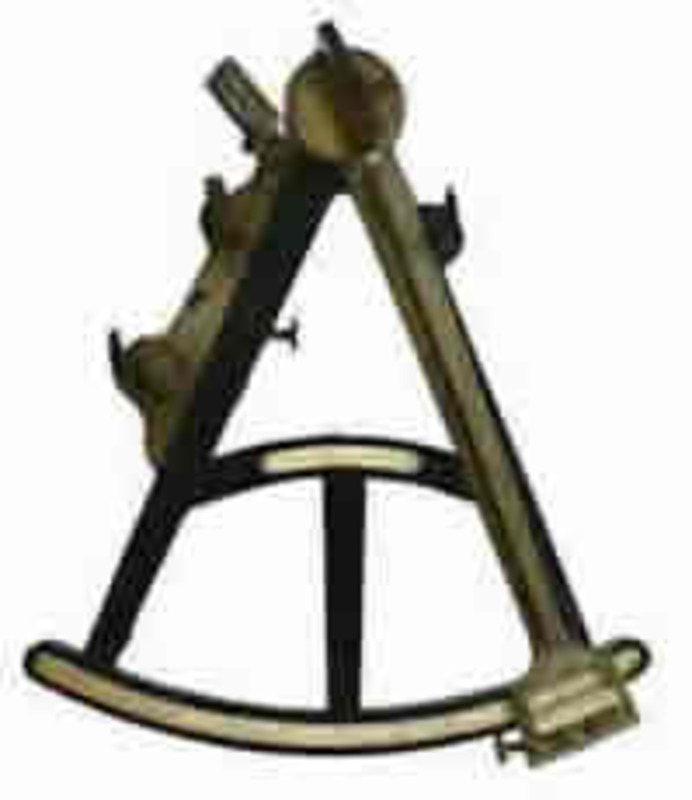
Octants were used principally to determine latitude by measuring the angle between the sun and the horizon. The instrument had a simple 'A' shape and its legs formed an angle of 45° hence its name (from Latin octans = one-eighth). Because the octant's two-mirror system used the principle of reflection it could measure an angle of 90° thus the instrument sometimes was also called a quadrant. Most were made of hard tropical wood. The index mirror was attached to the index arm usually 12 to 14 inches long. The fore-horizon glass (half mirror-half clear glass) was affixed to the leg nearest the reflecting surface of the index mirror. A peep site was located opposite the horizon glass on the other leg of the 'A'. The octant that Lewis and Clark used was also equipped with a back-horizon peep sight and mirror. This allowed them to measure the altitude of the sun when it was greater than 60° above the horizon (early April until late August along their route.) This octant purchased in Philadelphia for $22 is similar to the one used by Lewis and Clark.