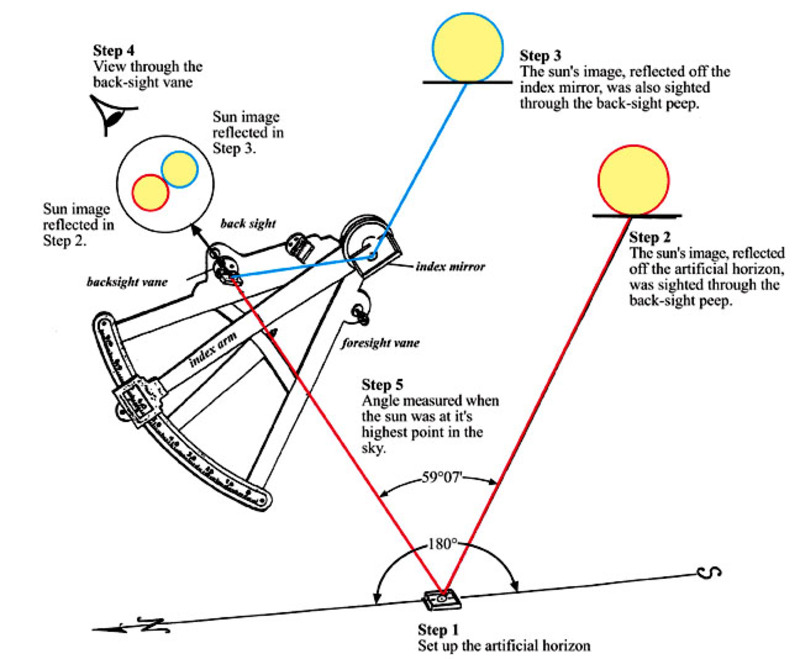
Taking a Noon Observation with the Octant and Artificial Horizon by the Back Method.
Description:
Using the Octant to take the observation. When the sun's noon altitude was greater than 60 degrees (April - September) Lewis and Clark used their octant, which was equipped for the back-sight method (see Equipment). Using the back-sight method, their octant theoretically could measure an angle between two objects up to 180 degrees. 1-Shortly before noon on July 29, 1805. Lewis prepares to take an observation of the sun for latitude. Because mountains to the south rise above the natural horizon, Lewis prepares an artificial horizon using a tray filled with water; the water will form a level surface and reflect the sun's image to his eye. 2-Lewis places his eye to the octant's back-sight vane. He then looks through a slit in the back-sight horizon glass and finds the image of the sun reflected from the water in the tray. 3-While still sighting the sun's image reflected from the water, Lewis moves the octant's index arm with its index mirror until the sun's image is reflected from the index mirror to the back-sight horizon mirror and then to his eye. Because Lewis wants to obtain the altitude of the sun's lower limb he brings the two images together so that the bottom of the sun's image reflected from the index mirror just touches the top of the sun's image reflected from the water. 4-As the sun continues to move toward its highest point in the sky for the day (noon), the two images of the sun overlap. To keep the two images in contact at a single point, Lewis turns the tangent screw on the octant's index arm, gradually decreasing the angle measured by the index arm. 5-Lewis keeps the two images just touching each other. When the two images stop overlapping, Lewis knows that the sun has reached it highest point in the sky. The images remain just touching each other for ten seconds or so, then begin to separate as the sun slowly descends. Lewis, however, already has clamped the index arm in place and, with the help of the vernier, reads the angle on the graduated arc as indicated by the zero mark on the index arm. That angle is 59°07'.
"Taking a Noon Observation with the Octant and Artificial Horizon by the Back Method.", Lewis and Clark in Montana, Montana Bureau of Mines and Geology